codex-slides: Open-source MCP slide studio for developer workflows
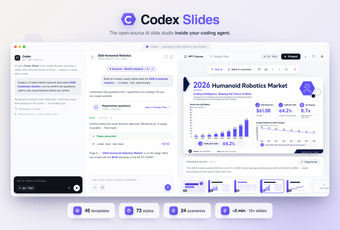
codex-slides, created by Nexu Io, is an open-source AI slide studio that converts prompts, repositories, or local files into presentation decks inside a development workflow. The app automates research, outlining, styling, and rendering so teams can produce production-ready slides without switching tools. It offers render-quality settings and a visual library to shape output. The target users are developers and technical presenters who need fast, local-first deck generation integrated with coding agents.
How the tool integrates with developer environments
The app runs as an agent-native studio inside MCP-enabled hosts and connects to tools such as Claude Desktop, Codex CLI, and IDE extensions, which keeps generation inside existing sessions. It exposes a browser-first interface and requires Node.js to run locally on macOS, Windows, and Linux. This setup lets teams keep presentation work adjacent to code repositories and agent activity, reducing context switching between separate design platforms.
What the generated slides look like and how they export
codex-slides produces image-native decks where each slide is a visual canvas and supports 1K, 2K, and 4K render quality across five aspect ratios. The package includes 118 visual systems and 45 curated deck templates to guide aesthetics. Completed presentations export to production-grade PPTX and print-ready PDF formats with speaker notes preserved, which fits handoff to traditional slide workflows.
How generation speed and scenario handling affect output
The studio offers a parallel rendering Fast mode that renders pages concurrently, enabling a 10-plus slide deck to be produced in roughly four to five minutes, a practical time for iterative drafting. It includes 24 guided scenarios, including localization, so the model can generate research-driven outlines, data stories, and translated content; outcome quality varies by prompt clarity and source material.
Data control, storage, and operational assumptions
The project uses a local-first file model, storing projects on the user’s disk and shipping under an open-source license, which supports zero-lock-in workflows. The app runs on existing coding agent logins with no extra API keys required. These choices place file control and deployment responsibility on the user and their host environment rather than an external service.
A practical choice for developer teams who accept AI drafts
codex-slides is a practical option for developers embedded in MCP who need rapid, locally managed slide drafting. Expect the tool to produce ready-to-edit visual drafts efficiently, and plan to review generated text and localized content manually before final delivery. For teams that prefer handoff to standard slide formats and keep assets on disk, the app aligns with that workflow while requiring active oversight of AI outputs.